(901) 235-1803

 17 Min Read
  September 1, 2026
 A homeowner’s guide to comparing the price you pay now with the cost of owning the roof over time.
Asphalt shingles usually cost less to install. Metal roofing usually carries a higher upfront price but has a longer expected service life. What gets missed in a lot of comparisons is time. The better financial fit can change depending on how long you expect to own the home, what system is being quoted, and whether another full replacement is likely to fall inside that ownership period.
That means there is no honest universal answer to “Which roof is cheaper over its life?” A useful comparison has to start with comparable quotes, realistic service-life ranges, and the costs that can show up after installation—not just the number at the bottom of today’s estimate.
The comparison at a glance
| Factor | Asphalt shingles | Metal roofing | What it means |
|---|---|---|---|
| Upfront installed cost | Usually lower | Usually higher | Asphalt is easier on the initial budget. |
| Expected service life | Shorter planning range | Longer planning range | Long ownership periods make replacement timing more important. |
| System complexity | Widely standardized residential installation | Varies sharply by standing seam, metal shingles, panels, finish and details | “Metal roof” is not one product or one price. |
| Warranty | Product- and system-specific | Product- and system-specific | Warranty length is not the same as expected roof life. |
| Best fit | Often strongest when upfront affordability matters | Often strongest when long-term ownership and longevity matter | The house, scope and ownership horizon decide the tradeoff. |
Start by comparing the same roof scope
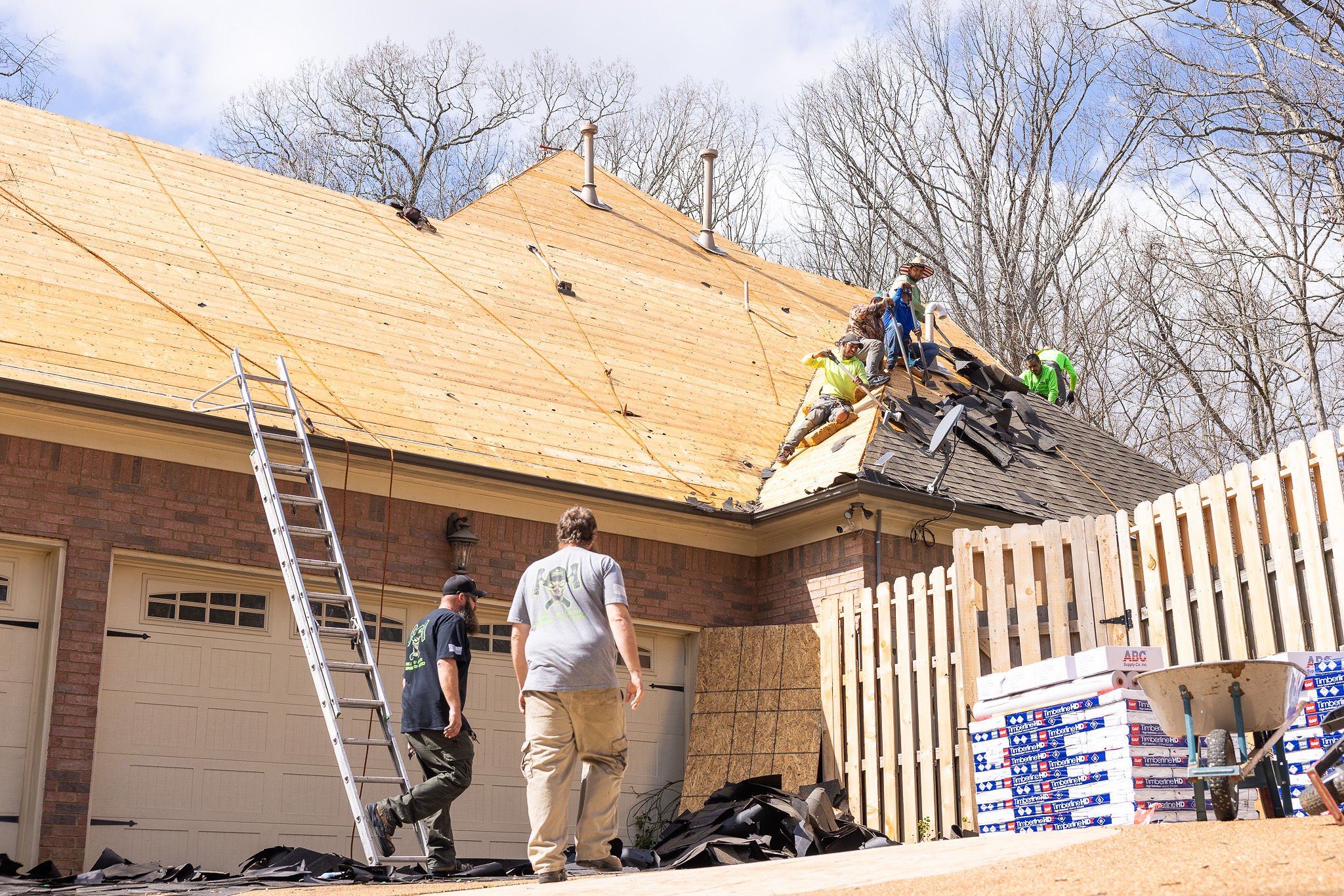
One of the easiest ways to get a bad answer is to compare two prices that cover different work. A metal estimate may include a different underlayment, flashing package, ridge treatment, accessory system or labor scope than an asphalt estimate. Roof size, pitch, valleys, penetrations, existing layers and damaged decking can move either number.
The Journal of Light Construction’s 2025 Cost vs. Value benchmark is useful because it defines standardized replacement scopes. Its asphalt project removes the existing roof to the sheathing and installs 30 squares of fiberglass asphalt shingles with underlayment, drip edge and flashing. Its metal project removes the existing roof and installs 3,000 square feet of prefinished standing-seam metal roofing with matching accessories. Those are benchmarks—not Summit prices and not a substitute for an inspection.
What the 2025 regional cost benchmark shows
Across three JLC regions relevant to Summit’s broader Mid-South market, the standardized metal project cost more than the standardized asphalt project. The difference was roughly $15,000 to $20,000 in these examples.
| 2025 region | Asphalt benchmark | Metal benchmark | Difference |
|---|---|---|---|
| East South Central | $25,939 | $41,256 | $15,317 more |
| West South Central | $27,116 | $44,505 | $17,389 more |
| West North Central | $30,693 | $50,520 | $19,827 more |
Source note: JLC 2025 East South Central, West South Central and West North Central. These are standardized 2025 project estimates, not local bids or Summit pricing.
The benchmark is most useful for one conclusion: metal often asks you to spend more on day one. It does not tell you whether that premium is worth paying for your house. For that, you need to look at time.
Service life is a range, not a replacement date
This Old House’s 2026 comparison uses a broad planning range of about 15–30 years for asphalt shingles and 40–70 years for metal roofing. The Metal Roofing Alliance uses different ranges—12–20 years for asphalt and 30–50+ years for metal. That disagreement is useful because it shows why a lifespan number should never be treated like a countdown clock.
Actual service life depends on the exact product and roof system, installation quality, ventilation, roof geometry, weather exposure, maintenance and damage over time. “Metal” also covers very different systems. Summit’s current metal-roofing page, for example, describes both metal shingles and standing-seam systems. Those should not be treated as identical products simply because both are metal.
The better long-term question: what will the roof cost while you own the home?
A more useful comparison follows the logic behind NIST’s BEES life-cycle cost method. NIST’s economic framework looks beyond the initial investment and includes replacement, operation, maintenance and repair, and disposal over a study period. For a homeowner comparing roofs, that can be simplified to a few practical inputs.
You do not need a finance model to use the idea. Start with the period that matters to you. If you expect to move in five years, a replacement that may happen decades from now has less direct value to you than it does to someone who expects to keep the property for 30 or 40 years. If you expect to stay long term, the chance of paying for another full roof becomes much more relevant.
| Planning horizon | What changes | What to compare |
|---|---|---|
| Short ownership horizon | Upfront cost usually deserves more weight. | Compare what you will actually benefit from before you sell. Do not assume a future buyer will reimburse the entire upgrade premium. |
| Medium ownership horizon | Either option may make sense. | Compare warranty terms, expected service-life range, maintenance, roof-specific risks and the exact premium for metal. |
| Long ownership horizon | Replacement timing matters more. | A longer-lived system has more time to deliver value if it avoids or delays another full replacement. |
These are planning categories, not break-even thresholds.
Other costs can change the answer—but they need to be treated carefully
Maintenance and repairs
Do not plug a generic annual maintenance number into a lifetime-cost calculator unless it is based on the system you are actually considering. A roof that needs a flashing repair, storm repair or localized replacement will not follow a neat annual budget. Ask each contractor what maintenance the proposed system needs, which components are expected to be inspected, and what is excluded from the warranty.
Energy performance
ENERGY STAR’s cool-roof guidance explains that a cool roof works through solar reflectance and thermal emittance—the roof’s ability to reflect sunlight and release absorbed heat. Metal can be part of a cool-roof system, but “metal” by itself does not prove any specific energy savings. Color, coating, insulation, ventilation, climate and the rest of the building still matter.
Insurance and resale
Insurance and resale are both property-specific. Some insurers may price policies differently based on roof material, impact rating, location or underwriting rules, but there is no universal discount that should be built into your roof budget. Ask your insurer about the exact product before assuming a premium change.
The same caution applies to resale. A better roof can be attractive to buyers, but estimated resale value is not the same thing as guaranteed payback. If you may sell soon, compare the metal upgrade cost with your actual ownership plans rather than assuming you will recover every extra dollar at closing.
Financing changes cash flow, not the underlying roof economics
If the upfront premium is the main obstacle, Summit offers roof financing through Service Finance. Financing can spread payments over time, but it should not be used as proof that one material is the better long-term value. Compare the roof first, then evaluate the financing terms you are actually offered.
When asphalt shingles make more sense
Asphalt deserves a serious look when lower upfront cost is the biggest constraint and the roof system still meets your needs. It can be a particularly practical choice when:
- you are working with a tighter replacement budget;
- your expected ownership period is shorter than the time needed for metal’s longer service life to matter to you;
- you prefer the look, repair familiarity or product choices available in asphalt shingles; or
- the metal premium in a roof-specific quote is larger than the long-term benefit you reasonably expect to use.
How to compare two roofing quotes fairly
Before you compare the bottom-line prices, check that both contractors are pricing the same job. A useful side-by-side review should cover:
| Check | What should match | |
|---|---|---|
| 1 | Roof area and complexity | Same measured area, pitch, valleys, hips, penetrations and access assumptions. |
| 2 | Tear-off and disposal | How many existing layers are removed and what disposal is included. |
| 3 | Decking repairs | What inspection is included and how damaged decking will be priced. |
| 4 | Underlayment and water protection | Exact underlayment, ice/water protection and where each is installed. |
| 5 | Flashing | Chimneys, walls, valleys, skylights, vents and other transitions. |
| 6 | Ventilation | Whether attic/ridge/intake ventilation changes are included. |
| 7 | Roofing system | Exact shingle or metal system, product line, finish/coating and accessories. |
| 8 | Ridge, edge and trim | Ridge caps, drip edge, gable trim, closures and related metal details. |
| 9 | Gutters and skylights | Any removal, replacement or integration work that changes scope. |
| 10 | Warranty | Manufacturer coverage, workmanship coverage, exclusions and transfer terms. |
| 11 | Exclusions | Items that could become added cost after tear-off or inspection. |
| 12 | Payment and financing | Separate the project price from the cost of financing it. |
Frequently asked questions
Is a metal roof always cheaper over the long term?
No. Metal can become more competitive over a long ownership period because its expected service life is longer, but the result depends on the installed premium, replacement timing, maintenance and repair costs, and how long you keep the property. A universal break-even year would be misleading.
How much more does metal roofing cost upfront than asphalt?
In the 2025 JLC regional benchmark used above, the standardized metal project was about $15,000 to $20,000 more than the standardized asphalt project across the three regions shown. That is a benchmark comparison, not a price range for Summit or for a specific house.
Does a metal roof really last twice as long as shingles?
It can, but “twice as long” is too neat to use as a promise. Current published ranges vary by source, and the real service life depends on the exact system, installation, weather exposure and maintenance. Use lifespan as a planning range and compare the warranty separately.
Does a lifetime shingle warranty mean the roof lasts a lifetime?
No. For example, GAF defines “Lifetime” warranty coverage according to the qualifying owner and property, with coverage terms and restrictions. That is a warranty definition, not a prediction that the roof will physically last for the owner’s lifetime.
Will a metal roof lower my energy bills?
Possibly, but the roof material alone is not enough to predict savings. Cool-roof performance depends on solar reflectance and thermal emittance, along with the roof color or coating, insulation, ventilation, climate and building conditions. Ask about the rated properties of the exact product being proposed.
What is the best way to compare asphalt and metal quotes?
Make the scope match first. Confirm the same roof area, tear-off, decking assumptions, underlayment, flashing, ventilation, accessories, warranty and exclusions. Then compare the upfront price and how each system fits the number of years you expect to own the home.
Sources
The article relies on the following current or primary sources for cost methodology, lifecycle costing, energy-performance guidance, warranty language and service-life context:
- NIST — BEES Online: Life Cycle Analysis for Building Products — life-cycle cost categories and methodology
- Journal of Light Construction — 2025 Cost vs. Value Report — standardized roof-replacement cost benchmarks and methodology
- ENERGY STAR — Cool Roofs — solar reflectance and thermal emittance guidance
- GAF — Shingle Comparison / Lifetime Warranty Definition — GAF-specific “Lifetime” warranty definition
- This Old House — Metal vs. Asphalt Roofing (2026) — current editorial service-life comparison
- Metal Roofing Alliance — FAQs — metal-industry service-life context, used with attribution